Yves Tanguy Biography
A biography of Yves Tanguy. surrealist-surrealism
Yves Tanguy 1900-1955
Indefinite divisibility. c1942
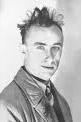
Raymond Georges Yves Tanguy was born on January 5, 1900, in Paris in the Navy Ministry. There his father Felix, a retired Navy captain lived and worked as a warrant officer after spending many years in service at sea.
His father married a girl from Locronan havng already borne three of his children.
In 1903 he then gets assigned to the hydrographic side of the navy. This resulted in the young Tanguy spending most of his childhood living at 13 rue de l'Universite.
Both his parents originated from Breton, France and so after his father's death in 1908, his mother moved back to her native Locronan, Finistère. There his mother's forced to ask for and obtain the licence of a tobacco shop. As a result, he spent most of his youth living with various different relatives. Finding himself entrusted for four years to relatives living in Plestin Les Grèves, on the Côtes d'Armor. As a teenager, he eventually returned to Paris and entered Secondary School at Lycée Montaigne in 1912. He then further pursued his studies at Lycée St Louis. When in 1916 his mother retired at the Prieuré, an ancient house in Locronan, Yves remained in Paris on Coëtlogon street in the Sixth Arrondissement, under the supervision of his sister Emilie who was a teacher.
Tanguy meets Jacques Prévert.
In 1918 he joins the merchant navy but this only lasts for a short while before becoming drafted into the Army. While in the army he became friends with Jacques Prévert, a French poet and screenwriter. Jacques Prévert, would later be instrumental in his career.
In 1922, he returned to Paris after finishing military service and worked various odd jobs.
By chance, he stumbled upon a painting by Giorgio de Chirico, an influential pre-Surrealist. Tanguy's so deeply impressed by his work that he decides to become a painter himself despite the fact that he had had no formal training.
During 1924 his friend Jacques Prévert introduced him into the circle of Surrealist artists. This centred around André Breton a French writer, poet, and surrealist theorist, who's best known as the main founder of surrealism.
Tanguy had a habit when working on a current painting of becoming completely absorbed with it. This way of creating artwork might have come about due to his very small studio which could only comfortably have enough room for one wet piece.
Yves later perceived by his friends and fellow artists as a Breton infused with a Celtic imagination, according to the "Abridged Dictionary of Surrealism". In fact, he was very attached to Locronan and the beaches of Douarnenez where he joyfully spent his holidays.
Tanguy developes his own style.
Yves quickly began to develop his own unique painting style. Then in 1927, in Paris France, he gave his first solo exhibition. Later that year he also married his first wife. Its around this time also that he received his first contract. This would be for 12 works a year from Breton, but he could only manage to paint 8 works for him as he was on a fixed income.
In 1928 his work along with several other surrealist artists the likes of Jean Arp, Pablo Picasso and others are exhibited at the Galerie au Sacre du Printemps in Paris. During the 1930s he continued to exhibit his work in Paris, New York, Brussels and London. However, because of the disappearance of his brother Henri and the great affect the war had on him, he took to alcohol and the bohemian lifestyle associated with a struggling artist. This ultimately led to the failure of his marriage.
Yves Tanguy meets Kay Sage.
In 1938 Tanguy's introduced to Kay Sage , a fellow artist, by her friend Heinz Henghes a British sculptor. He held her work in high regard and they soon began a relationship. Following the outbreak of WWII Sage, being born in Albany, New York moved back. She then arranged for several of her French fellow artists to take refuge in America. Yves went with her and eventually after being together for two years, they married on August 17th 1940. The couple eventually moved to Woodbury, Connecticut where they were able to convert an old farmhouse into a studio. This was to be the place they would spend the rest of their lives together.
In 1942 he took part in the artists in exile exhibition at the Pierre Matisse Gallery in New York. Then in 1947 and organised by Breton and Duchamp he exhibited in the exhibition Le Surréalisme en 1947 in the Galerie Maeght Paris. Then in 1948 being the husband of an American citizen he was able to obtain citizenship to the USA.
In 1953 he visited Rome, Milan, and Paris during which time he exhibited in solo shows.
In 1954 he and his wife exhibited together at the Wadsworth Atheneum in Hertford. He also appeared in a film by Hans Richter called 8 x 8.
Yves Tanguy and Kay Sage are reunited.
Sadly in January 1955 Yves Tanguy suffers a stroke and dies at Woodbury. His bodie's cremated and his ashes preserved until the death of his wife. Eight months after his death a retrospective of his works shown at the Museum of modern art in New York.
Then in 1963 after completing a catalogue of her husbands work and suffering from almost complete blindness Kay Sage committed suicide. Her bodies also cremated and now together Yves friend Pierre Matisse scatters their ashes on the beach at Douarnenez which he loved so much in his beloved Brittany.