My Favourite Paintings and Biographies:  Bougereau. Giorgione Magritte. Titian. Turner.  Tanguy. Vermeer.
 
                    
Specialist Art,Craft, Hobbies, DIY pixel advertising,Arts Crafts Hobbies DIY materials,Pixel tutorial,Free Projects, Ideas,Information,Links,Advert design,Art Materials,Craft Supplies,Beads,Jewelry,Scrapbooking,Stamping,Card making Specialist arts crafts pixel advertising. Be seen first by placing your advert on the grid for all to see.The accidental art critic has been created as a means for all of us to express our opinions on works of art. We can all visit sites and read professional opinions about art but some of us see art in a different form. Paintings portray different meanings, to some a painting can portray passion or calm while to others it can seem crude, macabre or just plain boring. You don’t have to be a student of art nor do you need to be an artist. Now is your chance to say it how you see it.Art Tutorials,Create your own artwork, Airbrushing tutorial, Promotional Art, Drawing, animation art,fine art,artists
Clubs Course's and Workshops, Art courses directory, Visual arts academy, Jewellery courses and workshops, Pottery and ceramics,
Art for sale.Buy paintings and giclee prints from your favourite artists,Artist Biographies

Full of Kids crafts for those of you who love art and craft and love making new things. With creative projects including educational pages to help you with your homework,  puzzles, games and activities for you to enjoy and do at home.
illustrated tutorial pages dedicated to teaching the basic techniques of beading, Instructions, Detailed patterns ,  tutorials to help you make beautiful jewellery.Free Projects ideas and Information,
Packed full with sites offering Free Projects ideas and Information to help you find what you need to know or show you what to do
These ever growing pages are packed full of links to sites offering Free Projects ideas and Information,
Art and Craft related pixel sites,
Wether you Want to place an advert on our home page or just make a general enquiry or exchange a Link. Please feel free to contact us.
Detailed step by step instructions to make placing your advert easier.
Use this link to go straight to our pixel sales page,
view our banner exchange page


        TITIAN. (Tiziano Vecelli) 1485-1586


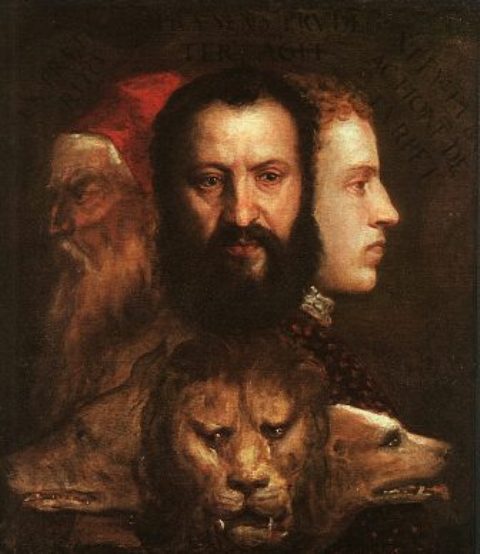
 Allegory of Age Governed by Prudence (c. 1565–1570) is thought to depict Titian, his son Orazio, and a young cousin, Marco Vecellio:


About the Artist:

Titian was born to Lucia and Gregorio di conte dei vecelli  in a small village of Pieve di Cadore in the Dolomite range of the Alps. Although there is much speculation and contradiction to his exact date of birth it is thought to be around 1485. His father was superintendent of the castle of Pieve di Cadore and also managed local mines for their owners. He was also a distinguished councilor and soldier.

When he was ten years old he was taken to Venice with his brother Francesco to stay with their uncle and began to study under the celebrated artist and mosaicist, Sebastian Zuccato. After 4 to 5 years he then went to study under Gentile Bellini and then Giovanni Bellini an established and well know artist of the time. While there he befriended several other young artists among whom were Giovanni Palma da Serinalta, Lorenzo Lotto, Sebastiano Luciani and Giorgio da Castelfranco, who would also become renowned in their own right.

In 1507 he joined the workshop of Giorgio Barbarelli da Castelfranco (Giorgione) as an assistant. Giorgione was commissioned by the state to execute frescoes on the re-erected Fondaco dei Tedeschi and it is believed that fragments of Titians work still remain. It was while working alongside Giorgione that he would adopt the style that would stay with him in his work to the extent that some of his earlier works could be accredited to Giorgione. He stayed for only 3 years as Giorgione died at the very young age of 33 which left Titian  to finish some of Giorgiones unfinished work. Giorgiones death along with the death of Bellini in 1516 would leave Titian in a league of his own within the Venetian school.

In 1510 Titian received his first important commission. It was to paint  frescoes in the Scuola del Santo in Padua, representing three miracles of Saint Anthony. The Miracle of the Newborn Child, The Healing of the Wrathful Son and  The Miracle of the Jealous Husband. Following this he began to win more commisions and establish himself in his own right.

In 1512 he returned to Venice and a year later he sets up a workshop with students such as El Greco, Tintoretto, Paris Bordone, Parrasio Micheli, Damiano Mazza and Polidoro Lanzani, he obtaines a broker's patent in the Fondaco dei Tedeschi, the outer facade was later to be painted by him. Termed La Sanseria or Senseria (a privilege much coveted by rising or risen artists), he became superintendent of the government works, being especially charged to complete the paintings left unfinished by Giovanni Bellini in the hall of the great council in the ducal palace. He set up an atelier on the Grand Canal at S. Samuele, the precise site being now unknown.

 In 1516- 1518 he painted  The Assumption of the Maddona, for the high altar of the church of the Frari, one of his most world-renowned masterpieces, It was seen as a marker in Titian's career establishing him as a more universal artist who drew his inspiration from outside the confines of Venice. (Now in the Venetian Academy). It excited a vast sensation, being indeed the most extraordinary piece of colourist execution on a great scale which Italy had yet seen. He continued to establish himself producing many similar works through the following years and continued to establish himself as a master of his art which made his work even more desirable.

In 1525 He marries Cecilia of whom little is known, which then makes their first child legitimate. More children were to follow. After the birth of Lavinia which led to the death of his wife during childbirth in 1530 he moved with his three children to the Bin Grande and left them and the house hold in the care of his sister Orsa. Around this time also he became very close to Pierto Aretino an Italian author, Poet, Play write and satirist who was influential on contemporary art and politics and invented modern literate pornography.

From 1530 onwards his reputation continued to grow through out Europe, and Federico II Gonzaga a client of Titians who he first met in 1523 introduced him to the Holy Roman Emperor Charles V, (in Bologna, where he was crowned that year). Titian also began to change his style and devotes himself more and more to the dramatic style. He starts using related rather than contrasting colours in juxtaposition (The act or an instance of placing two or more things side by side) using yellows and pale shades instead of the strong blues and reds which he used in his previous work. He continued his series of small Madonnas which he treated amid beautiful landscapes in the manner of genre pictures or poetic pastorals, the Virgin with the Rabbit  being the finished type of these pictures.

In 1533 he painted a famous portrait of the emporer Charles V which was based on a similar portrait  by the Austrian court painter Seisenegger. The emperor was so pleased with the finished piece that he appointed Titian court painter and elevated him to the rank of Count Palatine and Knight of the Golden Spur.

The most dynamic of all Titian's paintings of this period was the Death of St. Peter Martyr  in which the violent action of the piece was echoed in the convulsion of the old oak trees and sky. Toward the end of this period he painted The battle of Cadore which depicted in life size the moment at which the Venetian captain, D'Alviano fronted the enemy with horses and men crashing down into a stream in which he showed a more dramatic style and new release of vigour in his work.

In 1538 Titian creates  Venus of Urbino  one of the numerous paintings of a female nude depicting his ideal of female beauty.

The Venetian Government become dissatisfied with Titian as they feel he is neglectful of the on going work for the ducal palace. He is ordered to refund the money he had received when he was unemployed and another artist by the name of Pordenone in installed in his place. Perdenone dies soon after and Titian is reinstated. Around this time his position and worldly success is equal only to that of Raphael, Michelangelo, and at a later date Rubens.

In 1540 his work became more heavily influenced by the Mannerism of central and north Italy. He received a pension from D'Avalos, marquis del Vasto, and an annuity of 200 crowns (which was afterwards doubled) from Charles V on the treasury of Milan. Another source of profit, was a contract obtained in 1542 for supplying grain to Cadore, where he visited almost every year and where he was both generous and influential.

Titian had a favorite villa on the neighboring Manza Hill, from which it is concluded he made his chief observations of landscape form and effect. The so-called Titian's mill, constantly discernible in his studies, is at Collontola, near Belluno.

In 1546 he visited Rome where he was impressed buy the works of Michel Angelo and the remains of antiquity. He was given the freedom of the city. This honour had once also been bestowed on Michel Angelo in 1537. He was presented with the  opportunity to take over from the painter Fra Sebastiano in the office of piombo an offer to which he showed no reluctance in becoming a friar for the purpose, unfortunately the project lapsed due to his being summoned away from Venice in 1547 to paint Charles V and other subjects in Augsburg Germany. While in Rome his own paintings were gaining a lot of interest and he also painted the famous portrait of Pope Paul III and his Nephews (Museo di Capodimonte).

In 1548 Charles V summoned him again to Augsburg, where he painted both a formal equestrian portrait (Charles V at the Battle of Mühlberg) and a more intimate one showing him seated in an armchair (Alte Pinakothek)

In 1550 he was in Augsburg  again ,where he painted the portrait of Philip II. This was sent to England and proved a potent auxiliary in the suit of the prince for the hand of Queen Mary. He also painted several subjects over a period of approximately 10 to 15 years for the prince which depicted erotic mythological themes depicting a different style of painting, Forms gradually lose their solidity, partially dissolving into hazy paint textures with vibrant brushstrokes and there is a splendor of  colour. These pictures were  Danaë, Venus and Adonis, Perseus and Andromeda, The Rape of Europa, Diana and Acteon, and Diana and Calisto, and The death of Acteon. Another great work from this time and Perhaps one of his favourite works was Venus with a mirror. This canvas remained in Titian's studio until his death, and was the inspiration for many copies and variations. Due to the painting's superior quality, this is the only version that is universally recognized to be entirely the product of Titian's hand alone.

In 1554 the marriage of his beautiful daughter and subject of various works Lavinia took place. Being already betroved by him to Cornellio Sarcinelli of Serravalle. She had taken over the management of the household from her aunt Orsa who had died, and as he was providing a more than average income it placed her in a strong position. Sadly though like her mother and almost as if history was repeating itself she too died in child birth 1560.

In 1556 His close friend poet and writer Pietro Aretino dies suddenly.

In 1565 Titian went to Cadore . There  he designed the decorations for the church at Pieve, which were partly executed by his pupils. One of these is a Transfiguration. amoung other later works were Allegory of Time Governed by Prudence which it is thought to depict Titian, his son Oraziowho was alleged to be his favorite  and a young cousin, Marco Vecellio: He also painted Penitent St. Mary Magdalene.

For the remainder of his life he worked mainly for Prince Philip and devoted much of his time to portraits, becoming more critical of his work as he became evermore the perfectionist.

Although for every problem he undertook he furnished a new a formula he was unable to equal the emotion and tragedy or poetry of some of his earlier works such as The Crowning With Thorns or The Pilgrims of Emmanus.He had paintings remaining in his studio for up to ten years which he would keep returning too, to add a little detail or touch of colour or make a slight adjustment to. He also spent some time finishing off copies of  earlier works of his by his pupils, which created more problems of accreditation and priority of his works. Many of which were copied both before and after his death. He continually strived to develope new ideas and techniques within his work . His palette seemed to lack the freshness of his earlier work and his tone started to soften, the matter itself grew heavier and more dense and the variation lessened in resplendency and brilliance and yet some of his most moving pictures are those of his old age, the Dan of Naples and of Madrid, the Antiope, the Rape of Europa  other woks included Religion Succored by Spain and St Sebastian.

He continued to accept commissions to the very end and on 27th August 1576 being one of,  if not the greatest Renaissance painters of all time was seized by the plague which had its grip on Venice he died in his home in Biri Grande Venice aged around 91. He had originally wanted to be buried at the chapel of the crucifix in the church at Fran and had offered Franciscans a Picture of the Pietà intended for his own tomb, representing himself and his son Orazio before the Saviour, another figure in the composition being a sibyl. He never finished the work which resulted in differences arising and so he was interred in his home town of Pieve, Although other writings say he was buried in Santa Maria Gloriosa dei Frari in Venice.
It is beleived that the Pietà was finished by Palma il Giovane
. after his death.


Titian. The contents of these pages shall remain the property of www.Arts-Crafts-HobbiesandDIY.com copyright 2007